
Gyropure technology at FILTECH 2026 conference
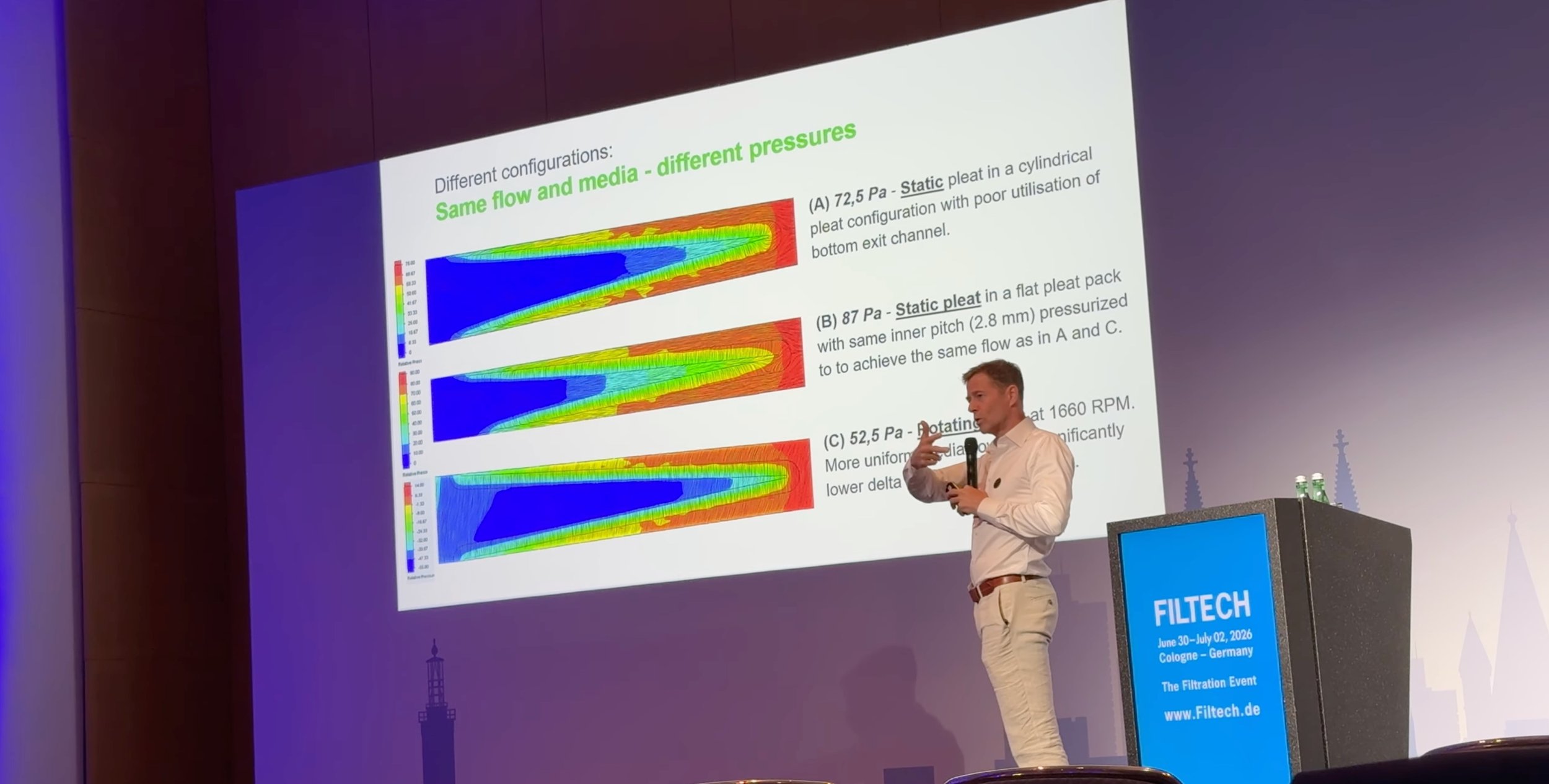
At FILTECH 2026 in Cologne, Peakvent's Morten Gulliksen presented a conference paper on the patented rotating filterfan: a single rotating assembly that merges the pleated filter and the impeller into one part. The paper lays out the physics behind drastic reductions in power consumption and noise, and the phenomenological formulas we use to compare air-handling configurations.
The patented rotating filterfan
Small size, high filter efficiency, low power and low noise are the four things every air-handling designer wants at once — and the four that fight each other. Push one and the others suffer. The real question is the optimal configuration of fan, filter, heat exchanger and ductings, and where the limits of physics actually sit.
Peakvent's inventor taught boundary layer theory as a scientist in the 1990s before setting a single goal: find the theoretically most efficient single-room ventilation unit. That search turned into a 30,000-hour puzzle of CFD and prototyping. Halfway through, the filterfan was invented — and it reframed the problem entirely.
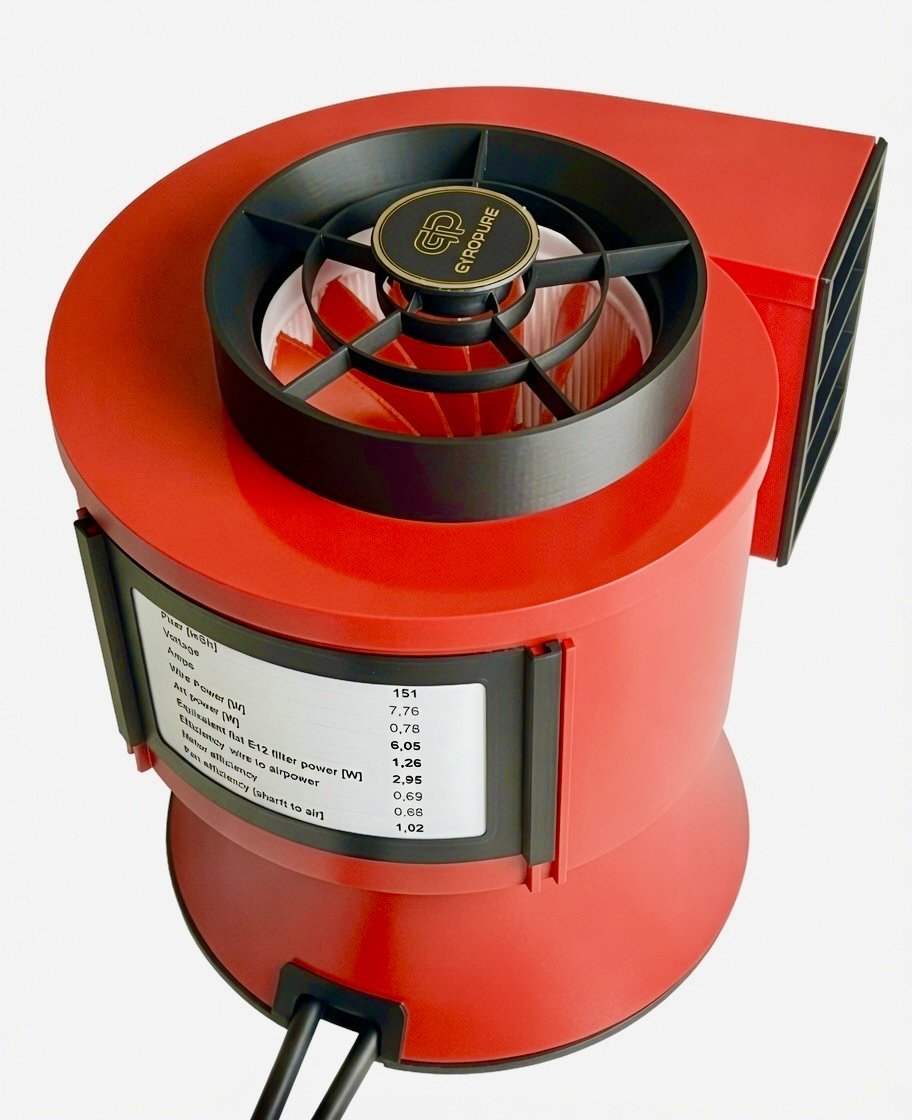
The filterfan is, in essence, a pleated filter wrapped around a specially designed impeller, spinning as one unit. Two ideas make it work. First, the law of large numbers keeps the assembly balanced even as the filter clogs. Second, the impeller feeds the filter by smearing high-velocity incoming air across the media in a laminar way — building pressure while avoiding turbulence loss. In a good design, roughly half of the pressure and flow comes from that impeller.
Noise is handled at the source: keep tangential velocities and Reynolds numbers below the point where noise onsets — typically around 9 m/s to stay under 30 dB@1m. The advantage holds at higher velocities too, and even at HEPA filtration.
To compare all the resulting configurations on equal terms, Peakvent developed phenomenological performance formulas. Across compact and larger systems alike, they point to more than a ten-fold improvement over conventional designs. The technique is described in patent US 12 050 020 B2, granted in the most significant markets.
If you design air-handling systems and want to know how the filterfan behaves in your specific application, ask us!